On the Jewish Question

On the Jewish Question
1
Late in his life the great philologist Erich Auerbach instructed readers how to love the world. Born a German Jew, he lost his professorship at Marburg under the Nuremberg Laws in 1936 and fled to Istanbul where he wrote Mimesis, an account of realism in Western literature from Homer to Virginia Woolf. After the war, he moved to the United States, eventually securing a position at Yale. He smoked, had hypertension. He looked at an ascendant America, an embryonic Israel, Europe in ruins. He wrote, “We must now return—albeit under different conditions—to what the pre-nation-state culture of the Middle Ages already possessed, to the knowledge that the human spirit itself is not national.” He quoted Hugh of Saint Victor, a twelfth-century canon regular. “The man who finds his homeland sweet is still a tender beginner; he to whom every soil is as his native one is already strong; but he is perfect to whom the entire world is as a foreign land.” This was not, for Auerbach, about the Christian life to come, but about this life.
II
An apocalyptic fever consumed the Jews of the Pale of Settlement, the western frontier of the Russian Empire, where the tsar mandated Jews live, where the largest population of world Jewry lived. Revolutionary socialists, Narodnaya Volya, The People’s Will, assassinated Tsar Alexander II, bombed his carriage. Rumors of Jewish conspirators sparked pogroms across southern Ukraine—the Storms of the South—catalyzing latent ferment. Narodnaya Volya’s executive committee made its position clear. “The people in the Ukraine suffer worst of all from the Jews. Who takes the land, the woods, the taverns from out of your hands? The Jews. From whom does the muzhik, often with tears in his eyes, have to beg permission to get to his own field, his own plot of land?—the Jews. Wherever you look, wherever you go—the Jews are everywhere. The Jew curses you, cheats you, drinks your blood.” Everywhere, fear. It felt like the end: the end of the Jew in Russia, the end of shtetl life. It felt like the beginning: a new exodus. It was 1881. Messiahs flourished.
America or Palestine. America was vast, absorptive, promised equal rights, freedom of religion, had mostly obliterated the natives. Palestine belonged to the Ottoman Empire, Jews would be subjects of the sultan, who wasn’t exactly keen on their coming—and Palestinians lived there. But it was Eretz Yisrael.
Colonization societies sprung up, hundreds of pioneers established settlements, funded by Baron Edmund de Rothschild from Paris. In 1882, Leo Pinsker published Autoemancipation!, calling for territorial sovereignty fourteen years before Theodore Herzl’s The Jewish State. Far more—tens of thousands—sought support from aid organizations in Paris, London, and New York to go to America, most to the Lower East Side where Jewish socialism blossomed among the tenements. A few were flung across the country to be farmers: Louisiana, Arkansas, Kansas. Sinykins to South Dakota on dispossessed Lakota land, now Jew Flats.
Back in the Pale, the fever broke. Hundreds of thousands—eventually millions—would leave, most to America, but millions would stay, the old world did not end, not yet. Only very few settlers persisted in Palestine and they lived with the supervisors installed by their patron, Rothschild, who wanted them to model simplicity and orthodoxy, to farm small plots and dress like the locals.
∞
Shloyme Zanvl Rappoport did not note the assassination of the tsar in his diary nor the pogroms that came after. He was busy corrupting the shtetl youth of Liozno. Born in a shtetl himself, his family moved to Vitebsk soon after, a small Belarussian city with a large Jewish population. His single mother ran a tavern where he grew up, absorbing street dialects and listening to the gossip and gripes of the drunk and poor. His best friend was a rich kid, Chaim Zhitlowsky. They read together: Haskalah, novels, Rappoport loved Les Misérables, which taught him, “it is enough to give one’s life for a conviction.”
Just seventeen, he went to Liozno and claimed to be a Russian tutor—an early mask in a life rich with them—leading Hasidic children off the path with heretical Haskalah texts. One day he left his diary unsecured, his landlady’s daughter found it, and, delighted, read its denigrations of the townspeople to a group of friends. The next day, one student’s mother told him, “I hired you to teach my girls to read and write, but not for you to write down that my Yakhninka’s nose is dirty, and that my Fridinka has big teeth, and that I go about in a bedraggled dress. I can assure you that even if I wear a bedraggled dress, whatever I put in the garbage is worth more than you.” He stuck around Liozno a little longer before leaving for the Russian heartland, enamored with the narod, the folk, socialist populism, sometimes teaching, sometimes working in the salt mines: “I felt I was in some legendary underground palace. In the light of some ten lamps, everything,” he wrote, “sparkled like millions of diamonds, stunning in its amazing beauty.”
But the beauty did not extend to the miners, subject to the iniquities of capitalism that tore them from their folk traditions. “All this, like slime, sucks in the weaker worker who comes from his home with the best intentions; it depraves him, forces him to forget his home, his family, his village, his agricultural interests, and it turns him into ‘a pure miner,’ in the full ugly meaning of the word.” To save the folk, the tsar—the new tsar—and his ministers had to die.
III
As a teenager in Odessa, Vladimir Jabotinsky was happy, and he was trouble. He skipped school and sassed back at soldiers. He did his classmates’ homework for pay. He wrote a set of essays on what I did last summer, inventing something new for each client. He and his friends produced a newspaper, Pravda, on a hectograph; he was a columnist; he bragged that his editor wielded his blue pencil most with him to avoid the school censor. While Nietzsche lay silenced and suffering from syphilis under his sister’s care a thousand miles to the northwest in Weimar, Jabotinsky cultivated a Nietzschean individualism, a belief in the primacy of the will. He didn’t think much about being a Jew.
In 1898, at seventeen, he—like many young Jews from the Pale—traveled West, to Switzerland, where, without a high school degree, he matriculated as a law student. On Bern’s narrow medieval streets he encountered ex-shtetl Jews, utterly unlike his cosmopolitan brethren from Odessa, and, “with their queer dress and manners,” they inspired in him an “instinctive revulsion.” He wrote, “I looked away in silence and asked: Can this people be mine?”
Nevertheless, he went to a lecture by an eccentric socialist Zionist, after which he wrote, “I don’t know if I’m a socialist, because I’m not yet well enough versed in the theory of it, but I’m certainly a Zionist, because the Jewish people is a dreadful one. Its neighbors hate it for good reasons. Its only hope of avoiding a ‘Bartholomew’s night’”—the massacre of thousands of Huguenots by Catholics in France in 1572—“is to move to Palestine.” For his part, after a few months, he moved to Rome. (He’d only gone to Bern because his mother wanted him to be around Russian Jews.) There he worked as correspondent, culture writer, and theater critic for an Odessa paper and lived a loud bohemian life, forgetting about his people again for a while.
∞
In 1861, Tsar Alexander II emancipated the serfs, more than twenty million people, more than a third of the empire, freed into crushing exploitation, whose freedom made way for the advances of capitalism. Resistance arose in turn. Socialists wrote. They agitated. By the 1880s, a group of socialist Jews in Vilna—today Vilnius in Lithuania—organized secretive reading programs for revolutionary literature. These grew and in 1895 the group sent emissaries to other cities in the Pale to organize the Jewish proletariat. Two years later, they reached a tipping point, and declared themselves a party, the General Jewish Labor Bund in Russia and Poland, or, simply, the Bund.
The Bund was illegal, thus underground. Only a year after its founding, in July 1898, many of its leaders in Vilna were arrested. Bundists in Switzerland, in Bern and Geneva, seized the occasion. Already the Bund was divided over the Jewish question. The internationalists, soon aligned with Lenin, believed that no special attention ought to be given to the Jews, that the Jews should dissolve into the proletariat, that the best route to Jewish liberation passed through class warfare. The nationalists—under the sway of Chaim Zhitlowsky in Bern—argued that the Jews ought to be recognized as a Yiddish-speaking nation and that the left ought to struggle for Jewish rights. A Bundist who possessed a printing press in Geneva took over Der yidisher arbeyter (The Jewish Worker) and made it a Bundist journal, and in its sixth volume published Zhitlowsksy’s essay, “Zionism or Socialism?”
Zhitlowsky, although influential among Bern Bundists, was a major figure in the Bund’s primary opposition on the left, the anti-Marxist Socialist Revolutionaries who rejected the theory that the proletarian revolution must pass through capitalism. To publish Zhitlowsky, then, was controversial. But Zhitlowsky offered a merciless skewering of Zionism, which had become—in the few years since the publication of Herzl’s The Jewish State and the establishment of the Zionist Congress—a manic craze, the Bund’s primary opposition on the right.
“Just as there can never be peace between the bourgeoisie and the worker so there can never be peace between Zionism and socialism,” he wrote. Herzl was petitioning world leaders and pled for Jewish quietism to mollify emperors and kings. Zhitlowsky ventriloquized him: “It has to be shown that the Jewish people is God-fearing, innocent, and far—so help us—from today’s revolutionary ideas; that the Jewish worker will not bring the terrible plague of socialism and class war to Turkey—heaven forbid!” Beseeching Zionist youth, Zhitlowsky wrote, “Everything you do, you are doing together with the bourgeoisie and, in the last resort, for the bourgeoisie. Every step you take damages the holy cause of the Jewish worker! Every penny you can take from a poor Jew is a crime against him.”
∞
On a winter’s night in 1901 the Bern Bundists threw a party to celebrate the twenty-fifth issue of the Bund’s Yiddish underground newspaper, Di arbeyter shtime (The Worker’s Voice). Everyone dressed up and wore red ribbons. They met in their meeting hall. Speeches were given, songs sung. Good feelings overflowed. Throughout, unnoticed, a wizened man sat quietly in the corner, smoking. Then he stood before them on the platform. “Comrades, I’ve just been inspired to write a poem, and have completed it. I would like to read it to you.”
Beneath the salty sea of human tears
A terrible chasm abides
It could not be darker, it could not be deeper
It is stained with a blood red tide
Much of this sea has been filled with sorrows
Endured by the suffering Jews
But only the tears of the poor ones are bloody
The rich cry as clear as the dew
The children of wealth, the enlightened, the clergy —
Into Zion they call the Hebrews,
We’ve heard this old story before from our enemies
“A ghetto for the eternal Jew!”
Messiah and Jewry are both dead and buried
Another messiah is come
The new Jewish worker will carry the banner
To signal that justice is done
The world freed and healed by this hero,
Who dives to the root of its wound.
In Russia, in Vilna, in Poland all hail now
The Great Jewish Worker’s Bund!
The gathered Bundists burst out in enthusiasm, some moved to tears. The poem, published a few months later under the byline Sinani, became a hymn sung by the Bund for decades to come. Its author, who generally went by S. An-sky, was not himself a Bundist. Only some months earlier, in January 1901, he wrote, “The devil knows how a little boy wants freedom—that’s how much I want to go to Bern.” He was thirty-seven but looked much older, was tired of Paris, tired of debating the Dreyfus Affair, ready for the youthful energy of a university town with its Russian Jewish colony of student émigrés. His childhood friend, Chaim Zhitlowsky, offered An-sky—né Shloyme Zanvl Rappoport—his couch. To the dismay of the Bund, they advocated terror to usher in the end of capitalism. In 1902, their comrade in the Socialist Revolutionary Party assassinated Russia’s interior minister, galvanizing dissent. They printed propaganda pamphlets in the tens of thousands, including one that ended with “a folk lay, a bylina”:
At dawn, early in the morning,
The sun came up, the red one,
From the great Zhiguli hills of the Volga.
It rose in the heavens,
It looks around with its bright glance,
It saw free clouds in the sky,
Free fish dance in the waves,
And above the flowers, the blue ones,
There’s no lord, no overseer...
And the bright sun looks at them
It smiles at their freedom.
By 1903, a double agent “reported to the Russian police that An-sky was the center of a ‘big gang’ of Bern radicals.”
∞
“When the shkotsim burst through the roof into the attic, the first thing they did was attack Zaytshik’s daughter. They struck her in the cheek with an object, and after she fell to the ground, they surrounded her.” So begins the testimony of the wife of a cobbler who lived on 11 Nikolai Street in Kishinev, in the Pale of Settlement, in today’s Moldova, as told to the poet Chaim Nahman Bialik. A month earlier a Christian boy disappeared and rumor spread that Jews killed him to use his blood for matzo. On April 6 and 7, 1903, dozens of Jews were murdered, hundreds raped, thousands left homeless in Kishinev. The Jews hadn’t suffered anything like it since the Storms of the South two decades earlier, and this was much worse than that.
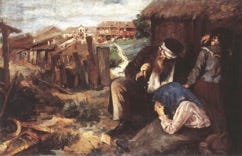
Abel Pann, “The Day After the Pogrom,” 1903
∞
Leading Jewish writers penned an open letter, published on April 20:
Brothers! The blood of our brethren in Kishinev cries out to us! Shake off the dust and become men! Stop weeping and pleading, stop lifting your hands for salvation to those who hate and exclude you! Look to your own hands for rescue!
A permanent organization is needed in all our communities, which would be standing guard and always prepared to face the enemy at the outset, to quickly gather to the place of riots any men who have the strength to face danger. We also believe that the government should recognize our just cause in asking for one thing alone: that they let us defend ourselves with our own hand. If the lack of human rights has led us to these straits, where even our blood is unprotected in the eyes of the people of this land—would they also wish to deprive us of the natural right of every living creature to defend itself inasmuch as it is able?
∞
The Central Committee of the Bund delivered a proclamation:
What, then, should we do during the pogroms themselves?
We must answer violence with violence, no matter where it comes from. Not with sweet words but with arms in our hands can we prevail upon the frenzied pogromists. We mustn’t hide in attics but must go out face to face, “with a mighty arm,” to fight these beasts.
Let not the Kishinev pogrom weaken our faith in our sacred ideal. With hatred and with a threefold curse on our lips let us sew the shrouds for the Russian autocratic regime, for the antisemitic band of swindlers, for the whole capitalist system. May the number of conscious and active fighters for socialism keep growing; may the solidarity with our fellow workers of other nations keep on growing!
Down with anti-Semitism!
Down with Tsardom!
Long live international proletarian solidarity!
Long live socialism!
∞
The morning after he learned about Kishinev, Jabotinsky burst into an editorial meeting at his Odessa paper, “turned to the non-Jews on the staff, berated them and the entire Christian world for what had happened, and stormed back out, slamming the door behind him.” Since returning to Odessa in 1901, he had become a convert to Zionism, reading Moshe Leib Lilienblum, Leon Pinsker, and Theodor Herzl, and had taken up the cause of Jewish self-defense. He showed up with two friends one evening at Jerusalem, a secret militia in Odessa, glanced around, and said, “You look dead tired; let us spell you for a while.” He worked overnight printing flyers while the others slept: “Let there be an end to the shameful heritage of centuries in which we went like sheep to the slaughter,” the flyers closed. “All for one and one for all! To arms in our own defense!” After Kishinev, Jabotinsky “toured the sites of devastation, spoke to survivors, and visited the injured in the hospital.” He translated Chaim Nahman Bialik’s poem, “In the City of Slaughter” into Russian—a passionate call for resistance written out of Bialik’s experience gathering witness testimony—which became a sensation.
Four months later, Jabotinsky attended the Sixth Zionist Conference—his first—which featured a dramatic, surprising proposal.
∞
Theodor Herzl was, by age, a contemporary of An-sky and Zhitlowsky, but from another world, born outside the Pale in Hungary to wealthy, German-speaking, assimilated Jewish parents who moved to Vienna, the fin de siècle Vienna of Brahms, Freud, and Wittgenstein. Like Jabotinsky fifteen years later, Herzl studied law then left town to serve as a foreign correspondent—in Herzl’s case, to Paris to write for Vienna’s Neue Freie Presse. He and An-sky might have passed each other on Champs-Élysées or sat near each other at cafés in the early 1890s, scribbling their feuilletons. If so, and if Herzl recognized An-sky as an Eastern European Jew, he might have pitied him, or recoiled in shame.
Centuries of subjection had warped the Jews, Herzl thought—coerced by those in power to be merchants—into a “money worshipping people.” He wrote, “at some dark moment in our history some inferior human material got into our unfortunate people and blended with it.” He bore a special distaste for Jews from the Pale, who, according to scholar Jacques Kornberg, he saw “as economically parasitic, shunning productive labor, physically feeble and timid, and wholly given over to an overly cerebral Talmudism.” He disdained Yiddish as a mongrel jargon. For most of his life he believed that Jews should assimilate into European society.
But in the 1890s, with the rise of antisemitism in Austria, France, and Germany, he began to feel that Jews would need to act boldly to claim honor under the gentile gaze. He proposed a mass conversion of Austrian Jews to Christianity, performed “with festive processions” in front of St. Stephen’s Cathedral in Vienna, in alliance with the Pope. He dreamed about challenging leading Austrian antisemites to duels. “If he were shot,” wrote Kornberg, “outrage would be unleashed against antisemitism for bringing about such a senseless loss of life. If his opponent were shot, Herzl would graciously express his sorrow at his trial and eloquently expound on the Jewish question, moving the awed jury to acquittal.” Though a lifelong liberal, he spitefully imagined mass Jewish commitment to socialism.
Then, in early June 1895, he was overtaken by the idea of a Jewish state. He wrote feverishly. “My only recreation was listening to Wagner’s music in the evening, particularly to Tannhäuser, an opera which I attended as often as it was produced, only on the evenings when there was no opera did I have any doubts as to the truth of my ideas.” Once, in the ancient past, when they had a state, a kingdom, the Jews were a proud and heroic people. With a state, they could be again. They could transform their learned passivity into strength. They could be European. “We will have a university and an opera,” he told a friend, “and you will attend the opera in your swallow tailed coat with a white gardenia in your button hole.”
He published The Jewish State in 1896 and held the First Zionist Congress in 1897. He quickly accumulated a mass following. He traveled, petitioning world leaders for land where Jews would be sovereign, maybe in Argentina, maybe in Palestine, maybe in Sinai.
In 1903, shortly after Kishinev, the British came to Herzl with an offer, land in East Africa for his Jewish state. “The whole country bears considerable resemblance to the Sussex Downs, and, in parts, to an English park,” reported Britain’s Colonial Secretary, Joseph Chamberlain. “English roses bloom profusely, and all English fruits and vegetable can be cultivated.” Why such magnanimity? The British had just completed the Uganda Railway, navigating more than five hundred miles from Mombasa to Lake Victoria, at great cost. Imported Indian and local African workers had died in considerable numbers from illness or were eaten by lions. The point was to secure Britain’s imperial claim to the region and rebuff the Germans. But after all that, no one was taking the trains. They wanted Jews to take the trains.
To Herzl, it was a coup. Here it was. Kishinev underscored the urgency: Eastern European Jews needed to be removed to safety. If you will it, it is no dream. He unveiled the offer—which, though most the land was in Kenya, came to be called the Uganda Scheme—at the Sixth Zionist Congress in Basel in August 1903.
∞
Jabotinsky reported from Basel for the Odessa paper. He attended a caucus for Orthodox Jews and another for Hebraists. Herzl, of course, gave the keynote. “Unbending and magnificent, he has a profile like an Assyrian king’s in an old bas-relief,” Jabotinsky wrote. Despite his carriage, he was, Jabotinsky ambivalently concluded, after assessing his writing and his oratory, “a man of mediocre abilities who is nonetheless a great figure—a genius of no special talents.”
Herzl presented the Uganda Scheme. He had the backing of most Zionist leaders and Western European Jews. The vote was over whether to go ahead with an expedition to survey the land and consider the offer. It passed 295–176. Most those who voted no were Eastern European Jews and they were horrified. They revolted. They left the hall. Many wept. “Think,” wrote Jabotinsky, “of what it is like to belong to a tribe that must weep over its first political victory in 1,800 years!” For his part, Jabotinsky voted no, claiming in his memoirs years later that he had no good reason, that he did so just “because.” But in a dispatch at the time, he wrote, “Zionism leads only to Palestine.”
In a letter to a friend, he wrote, “I took the trip and it was boring and stupid and I wasted five hundred rubles doing it. At the congress I got whistled at,” heckled during his one short speech. “And the next day, that is, at night, I was caught by a policeman in flagrante delicto with a Zionist woman on the cathedral grounds.”
∞
On July 3, 1904, at the age of forty-four, Theodor Herzl had a massive heart attack, and died.
∞
On January 13, 1905, Nahum Wilbuschewitz stood on the deck of the steamer S.S. Africa at the entrance to Mombasa’s Kilindini Harbor. The temperature was a sultry eighty-six degrees. The young man leaned his five-foot, eleven-inch frame over the railing, patted his brow with one of the dozen handkerchiefs he had brought with him, and peered through rimless spectacles at the bustling Indian Ocean port. Mango trees and coconut palms swayed in the meager breeze. Barefoot porters pushed handcarts down gangplanks, across the pier, and up through the city’s alleyways that snaked between walls inset with ornate wooden gates. Balconies teetered overhead from whitewashed buildings. Minarets trimmed in green presided over the jumbled chaos. This was Wilbuschewitz’s first glimpse of Africa.
Wilbuschewitz—a name he shortened to Wilbusch—was the only Jew on the expedition. The other leaders, Major Alfred St. Hill Gibbons, an army veteran, and Alfred Kaiser, a naturalist, had considerable experience on the continent. Gibbons split them up to better cover the territory, which meant they would each write separate reports. But Wilbusch, who was supposed to meet up with Kaiser, who had established the main camp, got lost. He was lost for days. He lost his compass, too. He was terrified. He was starving. He ate locusts. Finally he was rescued by a group of porters bringing rice to the main camp. Once Wilbusch got there, he stayed there. He only explored the land for one out of their four weeks.
Gibbons wrote a favorable report. Kaiser and Wilbusch were negative. But Wilbusch’s report, in Gibbons’s estimation, was made up of “crude conjectures of a very limited and unmethodized experience, and I cannot recommend that it be taken into serious consideration.” Wilbusch did not recognize, for instance, that the rivers were dry and the grasses yellow because it was the dry season.
Or it’s possible that he did, but that he purposely sabotaged the mission. It’s unclear how much was incompetence and how much ill will. Historian Adam Rovner claims that Wilbusch was a double agent, working for Herzl’s adversary, Menachem Ussishkin, who was organizing an all out campaign against the Uganda Scheme across the Pale. Wilbusch attended the Sixth Congress and voted against Herzl. He then surveyed Palestine for the Russian Zionists. Ussishkin wanted Wilbusch to establish a factory there. From East Africa, Wilbusch got a message to Ussishkin. “The children of Ham will inherit the land in Africa, the children of Shem—the land in Asia.” Ussishkin took this to mean, “the Uganda question is over and done with.” And it was. At the Seventh Zionist Congress, with Herzl dead and unable to defend his plan, its detractors seized on Wilbusch’s report, and the Uganda Scheme was overwhelmingly defeated.
∞
“The soul is greater than the soil, and the Jewish soul can create its Palestine anywhere,” said Israel Zangwill, a prominent British novelist and playwright and, in Herzl’s absence, the leading advocate for accepting Britain’s East Africa offer at the Seventh Zionist Congress. Delegates began debating at nine in the evening and continued until four. After an adjournment, they voted down the British offer at noon. Within hours, Zangwill had gathered his compatriots at a nearby hotel to split from the Zionists and hold the first conference of the Jewish Territorialist Organization. In coming years, they would consider Angola, Honduras, Iraq, and Libya as sites for autonomous Jewish settlement.
∞
An-sky, Zhitlowsky, and the Socialist Revolutionaries (SR) took revenge for Kishinev on July 28, 1904, when an SR threw a bomb in the carriage of Russia’s Minister of the Interior, Vyacheslav Pleve, killing him. Pleve had been Director of Police when Tsar Alexander II was assassinated two decades earlier and led an aggressive campaign to snuff out the group that produced the assassins, Narodnaya Volya, predecessor to the SR—antipathy ran deep. A letter in Pleve’s name circulated that contributed to Kishinev’s incitement. It was forged. But the letter was convincing because Pleve, loyal to autocrats and the landed gentry, was an antisemite. One of the conspirators, on hearing the news, “dashed a glass of water on the floor and,” per a witness, “gnashing his teeth, shouted, ‘That’s for Kishinev!’”
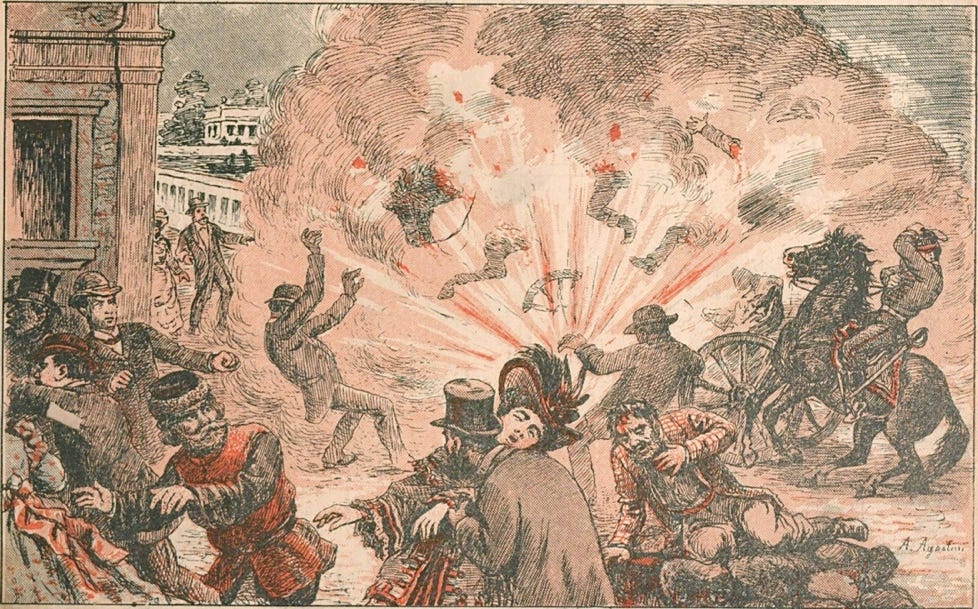
An-sky was in Paris for a meeting of the SR’s Foreign Organization. It was going poorly. “Pleve came to the rescue,” he wrote, “everyone was fighting, frowning—suddenly, bang! Hugs, kisses, champagne, hysteria.” Through the winter and into the spring he edited a series of hagiographic pamphlets celebrating fallen SR assassins. He traveled across Germany, fundraising for the SR. He also assembled a committee for Jewish self-defense that drew from groups otherwise hostile to each other: the Bund, Vozrozhdenie, Zionism. He kept moving that spring and summer, which wore on his body. He developed terrible hemorrhoids. In October, workers in Moscow and St. Petersburg staged a general strike. The SRs escalated with direct action. The pressure worked: the tsar issued the October Manifesto, committing to liberal reforms. But over the next two days, reactionaries exploded across the southern Pale in hundreds of pogroms.
∞
When they come they’ll come for you. An axe through the door, boots down the stairs, into this cellar where you hide with your mother and brother and sisters—Beili just five, a game to her, let it be—asleep on the cold dirt, October nights, no fire to warm you. You are nine. Unlike Beili, even Zalman, who’s seven, you know what pogrom means. That’s what they said, the goyim next door, your landlords, when they begged you to leave the heap of logs you call home for three nights and hide with them, beneath their feet (you hear them shuffle and stomp): “Cossacks,” “pogrom.” It passes you over this time. But when you next see the sun they have staved in the skulls of Jews in Semenivka and raped its women as they have across the Pale of Settlement these past two days.
Heading home after cheder you loiter in the tavern among shadows, dodging vodka breath, spilled kvass. Bundists lecture on Marx, Zionists fight over Uganda, Hasidim whisper of the Messiah to come. What is certain: Haskalah is dead in Europe. Progress shmogress. Emancipation a false god. Take arms or flee. Many, hundreds of thousands, have fled like father to America where Haskalah survives, there are jobs, you might own your home, Jews can be Jews, and the streets are paved with gefiltefish. Here if someone leaves a crust on their plate you eat it. If someone leaves soup in their bowl, you drink it.
Mother is unwell. She bakes through the night and takes to the street to sell bread with the sunrise. Luba, the oldest, works as a buttonhole maker at the clothing factory. Father was a jeweler here and is a jeweler in America and occasionally sends a money order. Once he had a sign outside your hovel but they tore it down before he left. You have enough to send Luba to America after a year and after another enough for the rest. A train to the border, steal into Germany at night, coyotes extort most of your money. A train to Rotterdam, a boat to London, a train to Liverpool, a hotel where the cockroaches march up out of the sink’s drain and take surveillance positions along the room’s seams. A ship to Montreal, a train to Sault Ste. Marie, an examination for lice, fleas, and trachoma. A train to Minneapolis, to father and Luba, where what little baggage wasn’t lost costs so much in customs that you forget it and begin with nothing. You are eleven, you and Zalman (call him Sol) and Beili (it’s Bess) assimilate quickly, you excel at school, take a job as an usher at the Orpheum Theater, see Sarah Bernhardt and Eddie Foy. You’ve matriculated into the University of Minnesota’s College of Dentistry when the army calls you up to fight Pancho Villa. You arrive at the border at Llano Grande, nothing but cactus, dig holes to sleep in. Time telescopes upon return, marriage, children, mother one day puts her head in the oven and turns on the gas, every year you remember to send season’s greetings into American Jewish World. You never know that every Jew who stayed in Semenivka was taken into a birch grove and shot. You grow old and die in Calabasas in 1981 but not before giving an oral account of your life, which is transcribed, digitized, embedded in a family tree, and read by your first cousin’s great-grandson decades hence, which compels him to try to understand your youth, to immerse himself in the scholarship on life in the Pale of Settlement, and to study what world Jewry dreamt before the State of Israel and what might still be possible.
∞
By November 1905, An-sky thought his revolution was happening in Russia. He couldn’t believe he was missing it. “Now every day is a year, every hour a phase,” he wrote. “In a few weeks or months of inaction you could sleep through the situation.” He decided to return. On December 4, he was in Berlin: “a revolution that one can’t miss is under way. The situation isn’t defined yet, and for that reason I must go now, to help it become defined.” He translated the Internationale into Yiddish. At the border, he learned a warrant remained in effect for his arrest. He retreated to Königsberg and leaned on connections in Russia to request amnesty. While he waited, a counter-revolution swept Moscow. His comrades and friends were arrested. His euphoric apocalypticism deflated. He entered Russia on New Year’s Eve, already disillusioned.
IV
An old man roamed the Pale, from shtetl to shtetl, and with him a retinue of younger men. He wore a rekel, a black frock coat, and was called Reb Shlomo. First thing they did was pray at synagogue, then invite the local men to their inn for whisky. Reb Shlomo asked questions, the local men spoke at great length, and Reb Shlomo blazed with dveykes, levitating off his seat. Reb Shlomo sought out healers, ancient women, and explained in a voice broken by the years that he was once rich but now was poor, his eyesight was failing him, he needed magic to make money. He would pay her for as many spells as she would share. She often shared. His retinue wrote it all down.
They sang with Hasids. They collected stories of dybbuks. Reb Shlomo convinced an old man to sell him the finger he’d sliced off as a child to avoid conscription in the Russian army.
This was, of course, An-sky. It was 1913. He was fifty but appeared, as always, much older, with his thick white beard and his engraved wrinkles. As a teenager, Les Misérables convinced him, “it is enough to give one’s life for a conviction,” and now his conviction was ethnography, which he envisioned as a totalizing encyclopedic project to save the folklore and ephemera of the world of the shtetl before it vanished. He developed an impossible questionnaire with 10,000 questions. He received the blessing of the academic authorities and Jewish philanthropists of his day, although they believed him a quixotic dreamer. He hauled a phonograph with him and recorded songs. He took photographs. He aimed to collect “old books, manuscripts, documents, Jewish art objects: mizrabim, ark curtains, carvings from pulpits, menorahs, decorated Torah scrolls, religious objects, women’s old adornments, old outfits, relics, objects connected to the memory of famous people or well-known events”—and fingers. Like modernists from Warsaw to Paris to Harlem, he believed that the path to national renewal passed through primitive folk traditions.
He was right about the vanishing shtetl. In 1914, WWI erupted. In 1915, the strictures of the Pale collapsed, Jews scattered. In 1917, the Bolsheviks abolished it. From then until 1921, the Russian Civil War, Reds versus Whites, decimated the shtetls of Ukraine, killing tens of thousands of Jews. Stalin forbade Shabbat and banned Hebrew; Soviet Jews, if they survived the Holocaust, forgot, many of them, over the years, that they were Jews.
∞
The British wanted a reason to explain their imperial ambitions for Palestine. And they wanted to stoke Jewish ferment to lure America into the war and tamp down Russian opposition to it. So on November 9, 1917, Lord Balfour published his declaration to Lord Rothschild, having consulted at length with Zionists but not with Palestinians, that should Britain win, it would establish in Palestine “a national home for the Jewish people.” (It made a separate, if less public, pledge to support Arab independence, also to curry support during the war.)
The next day, Vladimir Jabotinsky’s wife and son joined him in London. They went to the movies. Jabotinsky loved the movies. He’d had no part in the Balfour Declaration. But he was, by now, a committed Zionist, committed to Palestine, and had spent recent years lecturing across the Pale. Vladimir Nabokov’s father called him “the finest orator in all of Russia.” He’d also decided against socialism, for capitalism. He wrote, “Young Jews should be told: ‘Back to the shop counter! Back to the stores, the banks, the stock exchange!”
Jabotinsky had his own quixotic scheme. Early in the war, believing that Britain would win, he imagined a Jewish Legion fighting alongside the British in Palestine, making the case for a postwar Jewish state. He petitioned the commander of the British forces in Egypt, who turned him down. He had trouble securing meetings at first in London. He went to Copenhagen to sell the idea to the Zionist Executive, who did not support it. He struggled to acquire signatures for a petition from London’s East End Jews. But he didn’t stop. He plied what connections he had in London. He trained as an officer. Finally, in July 1917, the British approved a Jewish battalion, the 38th. It underwent basic training in Plymouth while Balfour signed his declaration and Jabotinsky went to the movies with his son. The British took Jerusalem before the 38th could get there. Jabotinsky saw action in the Jordan Valley. His Jewish Legion, which added the 39th and 40th battalions, played a small part in the war. But it gave him credibility. And it made him famous.
∞
One man, at least, understood Jabotinsky’s Jewish Legion from the beginning. An-sky had long advocated Jewish self-defense—even terror in the name of revolution. The war had put an end to his ethnographic project; instead, he traveled to Galicia; the Russian army was laying waste to the shtetls it crossed; An-sky entered a synagogue torn apart, stinking of shit. In the summer of 1915, he gave speeches to fundraise for Jabotinsky.
But his obsession was a play. He kept writing, revising, reading it aloud, asking for feedback. He read it that fall to Jabotinsky, who was then in Russia. It was called The Dybbuk, it drew from the supernatural tales he’d heard as Reb Shlomo, and it became the most staged Yiddish play ever.
On November 8, 1920, An-sky, fifty-seven-years old, died of a heart attack.
∞
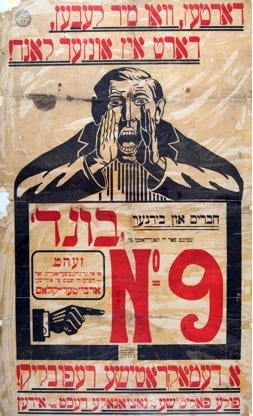
In 1918, after the Russian Revolution, the Bund campaigned for an election in Kiev. They issued pamphlets and posters, including one that announced, “THERE, WHERE WE LIVE, THERE IS OUR LAND!”
V
It is 1933. It is the Eighteenth Zionist Congress. The delegates are about to declare their protest against Nazi Germany, they are reading their declaration: and paramilitary youth storm the hall, whistling, jumping, dancing, clapping. In their midst, attentive, hands folded, with a faint smile, sits Vladimir Jabotinsky. This is Betar.
Born in Riga in 1923, it grew and grew, with Jabotinsky as its leader in perpetuity. “Its members practiced martial exercises,” wrote a historian, “were taught calisthenics and techniques of self-defense, drilled at marching and parading, wore military-style uniforms on formal occasions, were organized by rank, company, and battalion, had their own special salute.” It was his dream, Jabotinsky wrote, “to turn Betar into a worldwide organism that will be able, at a single command from its center, to execute instantly, with many tens of thousands of hands, the exact same thing in every town and country.” Was this, asked his critics, making men into a machine? “I propose that we answer proudly,” wrote Jabotinsky: “Yes, a machine!”
In 1925, at a Paris café, Jabotinsky founded the right-wing Revisionist Party. Six years later, with the collapse of Chaim Weizmann’s centrist General Zionists, it surged, taking twenty percent of the vote at the Seventeenth Zionist Congress. Now it was clear. There were two men struggling to claim Zionism, each believing himself the true visionary. Jabotinsky and David Ben-Gurion, the leader of Mapai, the labor party.
Ben-Gurion deemed Betar fascists and called Jabotinsky Vladimir Hitler.
Jabotinsky allowed himself to serve as a cipher. On the one hand, he was consistent in his published writing about his disdain for Hitler and his rejection of fascism. On the other hand, he embraced a paramilitary organization, which he founded, that exalted him as the unitary expression of its voice. Yes, a machine!
∞
One young Betarnik rose fast from the rank-and-file to regional commander in the east, to member of Central Command in Warsaw. In 1933, Menachem Begin was twenty years old. Like Jabotinsky before him, he traveled the country, now Poland not the Pale, to lecture on behalf of the movement.
∞
In 1935, Jabotinsky embraced shilat hagolah—Diaspora negation—that every Jew should be a Zionist, that every Jew would live in Palestine. The next year, Jabotinsky was named the supreme commander of the Irgun, which spun off from the Zionist military in Palestine out of frustration, to wage a fiercer struggle against the British imperialists and the Palestinians.
Jabotinsky restrained Betar and the Irgun. In 1938, in Warsaw, he urged Betar not to vote for a war of national liberation, to retain an official policy of self-defense. The leading voice to advocate for conquering the homeland now was Begin. Jabotinsky rebuked him. Begin wept.
In practice, Jabotinsky, banished from Palestine by the British, kept distance from the Irgun’s acts of terror against Palestinian civilians, exercised plausible deniability. Threatened with knowing too much, he said, “One doesn’t ask papa.” But with Nazis advancing, and almost nowhere for Jews to go, he changed his mind. “There is no war other than war against innocents,” he wrote, “if you don’t want to harm the innocent—die.”
He died, in the Catskills, at fifty-nine, of a heart attack, in 1940.
VI
Late one night in 1937 Bernard Goldstein used himself as bait. He walked into Miller’s Café, the hangout for the National Radical Camp (ONR) in Warsaw, Hitlerite fascists. It was down the street from the offices for ABC, ONR’s daily paper, an antisemitic rag. The Onerowcy taunted Goldstein, one raised his fist. Goldstein threw a bottle. It smashed against the wall. That was the sign: fellow Bundists rushed in to crack fascist skulls. Just as quickly they scattered, listening from sidestreets as the ambulances came.
“Only the Bund waged an organized fight against the antisemites,” said the Secretary General of Jabotinsky’s Revisionists, based in Warsaw. “We did not consider that we had to fight in Poland.” The opposite: Revisionists worked with the Polish government toward the shared goal of moving the Jews to Palestine. Betar imitated Polish nationalist youth.
The Bund maintained a militia that defended Polish Jews from antisemitic hooligans. It manned park gates on festival days, maintained informants who warned of imminent attacks, and avenged pogroms. But the Bund was also much more, a whole world. At its core, it organized workers: building unions, coordinating strikes. It promoted Yiddish, ran schools, fought evictions, led hikes, taught choirs, raised money for the ill, held summer camps and winter camps. Its children’s group, SKIF, and youth group, Tsukunft, grew to many thousands of members. The Bund’s Warsaw club featured a library whose reading room was always full; it hosted lectures, reading groups. “It was like an anthill,” wrote Goldstein, “seething with life.”
The Bund reached the peak of its power at the end of 1938 when it won seventeen of the twenty Jewish seats on Warsaw’s city council, accompanied by wins across the country. One of its leaders, Henryk Erlich, said that year, “What can a Jewish Palestine be, under the best of circumstances? If a Jewish state should arise in Palestine, its spiritual climate will be: eternal fear of the external enemy (the Arabs); and eternal struggle for every foot of ground and for every bit of work with the internal enemy (Arabs).” Erlich wondered, rhetorically, “Is this a climate in which freedom, democracy, and progress can grow? Indeed, is it not the climate in which reaction and chauvinism ordinarily flourish?”
VII
Sir John Shaw, long narrow face, grand forehead, right eye a bit bigger than the left, an old Repton boy, ever since a company man for the Empire, rose up the chain in the Gold Coast and came here, to Palestine, Chief Secretary, quite a good bit of trouble, this mess with the Arabs and the Jews, to the King David, gorgeous innit, gem of Jerusalem, pink Palestinian limestone, not a bad spot for offices, good enough for emperors and kings, potentates and princes, what’s the date again, July 22, 1946, when it happens: oh, oh, oh. The chandelier comes down. Dust and smoke. He steps into the corridor. Sightless black. Stops in time. The floor falls away. The building is gone.
The Postmaster General flew. The blast lifted him from the hotel, launched him across the street, and plastered his body against the wall of the YMCA.
Thirty-two minutes earlier, the Irgun arrived at the King David’s service entrance dressed as Arab laborers in a stolen delivery truck. They held the clerk and his colleagues at gunpoint. Inside, under the direction of Gideon—alias of Yisrael Levy, barely twenty, child Betarnik, joined the Irgun at fourteen—they placed seven milk churns each loaded with fifty pounds of explosive. By the time they got out, the Military Police were waiting. The Irgun killed two and took off on foot, catching their backup car and speeding off.
Menachem Begin, their commander, would be pleased.
Ninety-one died. The British began to wonder whether it was worth it.
∞
In 1947, Leyvick Hodes—a teacher and the son of a teacher; chair of the teachers’ union in Warsaw for more than a decade before the war; a prolific writer; a member of the Central Committee of the Bund; now in New York City—wrote an essay on the fifty-year struggle between the Bund and Zionism. After the war, after the Holocaust, Zionism was on the march. This, argued Hodes, was a shame. He held fast to Bundism: against the romantic attachment to a mythologized homeland, do’ikayt, hereness, the fight for the good life for all, here, where we are rooted:
“The idea of the Bund is deep belief in humankind,” he wrote. “The Zionist thinks he can run away from evil. Belief in humankind is not popular today. In these last years we have all seen it become deeply debased, trampled, and spat upon. But if man is by nature a beast, no amount of running away will help. If there is no tikkun, no redemption for mankind, then there is no redemption for the Jews. The beast will hunt those who run from it and find them everywhere. If the belief disappears, then every hope disappears. The victory of the Zionist idea is a victory of a failure to believe in mankind, it is a complete victory for hopelessness.”
Toward the end of the essay, he wrote:
“The Bund has always fought for continuity, for creative national life, for do’ikayt, for the right to remain rooted in the ground where the Jewish masses live and fight. This very idea received from Nazism the most painful blow. The remnants of the Jewish masses waste away in the camps, wander homeless along the roads, or float like splinters on the foaming waves of the stormy post-war world. But with every day it becomes clearer that the path to healing these wounds leads not through increasing the number of helpless wanderers, not through further uprooting, but through building and rebuilding. The work of rebuilding in Poland and the development of Jewish communities in France and Belgium are gigantic achievements not only for the remaining Jews in those countries, they can rightly be viewed as acts of the greatest historical importance for Jewish survival in the broadest sense of the word. The efforts to rebuild and to secure Jewish life in Europe robs Hitler’s heirs of the fruits of their victory over the Jews. The Bund has always pushed the Jewish people toward a creative national life, and even the smallest project—a workers’ cooperative, an orphanage, a school, a library—built and secured in the countries that should be, according to Hitler, ‘Juden-rein,’ is an expression that that force still lives, that in the depths of Jewish life in Poland and in other countries springs still trickle, which must and which want to flow again in fruitful streams of national creativity and continuity.”
He then fell ill and spent the rest of his life, the next ten years, in bed.
∞
Before dawn, one hundred thirty Zionist irregulars, some Irgun, some from the Lehi, the deranged Stern Gang, gathered on the Sharafa Ridge—today, Mr. Herzl, site of Yad Vashem—above the Palestinian village of Deir Yassin, a few miles west of Jerusalem, with its seven hundred and fifty denizens who were observing a truce with the Jews, stonecutters living on a rocky hillside, near a quarry, with their families. The irregulars, many of them teenagers, were armed, if poorly. Each carried two grenades. They planned to raid the village to resupply their bases and increase morale. Irgun commander Menachem Begin lay in bed thirty-five miles to the northwest, in Tel Aviv. It was April 9, 1948.
An Irgun truck, mounted with a megaphone instructing the villagers to flee, got stuck in a ditch; it’s unlikely anyone heard it.
The irregulars descended. They worked from house to house. They expected a quick victory, but resistance was fierce and lasted through the morning. After they took control of the village they went berserk and massacred old men, women, children. “An already wounded man was shot,” said Fahimi Zeidan, who was twelve, “and when one of his daughters screamed, they shot her too. They then called my brother Mahmoud and shot him in our presence, and when my mother screamed and bent over my brother (she was carrying my little sister Khadra who was still being breastfed) they shot my mother too.” They killed one hundred Palestinians. They ransacked their homes for anything valuable. They rounded up a few dozen survivors and paraded them through the streets of West Jerusalem.
Word spread quickly. Palestinians took flight. The massacre at Deir Yassin catalyzed the exodus of hundreds of thousands, abandoning hundreds of villages, into refugee camps, into diaspora.
∞
The Bund did not disappear, it scattered. It reconstituted as the International Jewish Labor Bund in 1947 in Brussels. It was strong in New York, Paris, and Melbourne. It had chapters in Buenos Aires, Montevideo, Rio de Janeiro, Mexico City, Los Angeles, Shanghai, Johannesburg, Montreal, and elsewhere. It faded with Yiddish across the decades, dissolving in 2005. Attempts to rediscover it, even revive it, if not in Yiddish at least with do’ikayt, have surfaced in recent years, in writings by Benjamin Balthaser, Daniel Boyarin, and Molly Crabapple, in a journal, Der Spekter, in a reincarnated organization incorporated as a nonprofit in the state of Iowa in 2024, and in what Jacob Plitman, writing in 2018 for the relaunch of the leftist Jewish Currents, named an emerging diasporism. Many now refuse even diaspora or do’ikayt as slogans, denying Israel the power of the center against which they define themselves as Jews.
VIII
Behind the Prime Minister, a face. Projected, tremendous. Hair shaved two inches above either ear, a deep sidepart, a curl at the forehead. Skull tapered in a V to a knob of a chin. Thick brows, lightly bunched. But it’s the eyes: direct into the lens, wrapped round by bold circular black frames. I have it, they say. A charismatic opacity for which Polish Jewish youth cheerfully became proud, noble, and cruel, and died. Betar, Irgun. It is 2023. It is a century since he wrote “The Iron Wall,” which is why the Prime Minister is speaking today on Mt. Herzl: to say that Israel is “continuing to successfully implement these principles.” The principles of the Iron Wall.
“Culturally they are five hundred years behind us,” wrote Jabotinsky. They are committed to their land as natives; they will not cede it willingly. “They feel at least the same instinctive jealous love of Palestine as the old Aztecs felt for ancient Mexico and the Sioux for their rolling prairies.” As everywhere, “the native population resists colonists as long as it has the slightest hope of ridding itself of the danger of being colonized.” The problem: “Colonization can have only one aim, and Palestinian Arabs cannot accept this aim.”
What must Zionists do? “Zionist colonization must either stop, or else proceed regardless of the native population,” and it will not stop. Zionists must build an Iron Wall, “a strong power in Palestine that is not amenable to Arab pressure.” Only by militant cruelty can Zionists crush the Palestinian resistance.
“We, the students of Jabotinsky,” says the Prime Minister, “are committed to Israel remaining a Jewish and democratic national state.” The Prime Minister’s father, Benzion, a tendentious scholar of the Spanish Inquisition and a zealot, was Jabotinsky’s secretary—Jabotinsky whose given name was Vladimir, but whose Hebrew name was Ze’ev, meaning wolf.
IX
On March 15, 2028, at the age of seventy-eight, the Prime Minister had a massive heart attack, and died.
X
Imagine the exodus. They wrap their menorahs in Israel Hayom, unscrew their mezuzahs. Rouse the children early, their clothes laid out the night before. “Mama?” Holiday nerves, the freedom of a new dispensation. “Are we really going?” Seven million unsettlers. They leave the doors unlocked, the keys under the mats. Out of Ashkelon, Haifa, Tel Aviv. Dismantle the Iron Wall. To New York, São Paolo, Buenos Aires. Disperse. To Paris, Amsterdam, Istanbul. Seas will part. To Johannesburg, Melbourne, Tokyo. A great undoing. Last one out turn off the Iron Dome. To Mexico City, Los Angeles, Vancouver. El Al’s last flight. Tikkun olam. Manna from dew. Going home.
Notes
He smoked Damrosch, David. Comparing the Literatures: Literary Studies in a Global
Age, 72–73
We must now return Auerbach, Erich. “The Philology of World Literature,” 264–265
An apocalyptic fever Frankel, Jonathan. Prophecy and Politics: Socialism, Nationalism, and theRussian Jews, 59
The people in the Ukraine Frankel, 98
Sinykins to South Dakota Clarren, Rebecca. The Cost of Free Land
supervisors installed Frankel, 126
Liozno Safran, Gabriella. Wandering Soul, 23–26
I felt I was in Safran, 39
All this, like slime Safran, 40
Vladimir Jabotinsky was happy Halkin, Hillel. Jabotinsky, 8–9
cultivated a Nietzschean Horowitz, Brian J. Vladimir Jabotinsky’s Russian Years, 22
In 1898, at seventeen Halkin, 17
with their queer dress Halkin, 17
I don’t know if I’m a socialist Halkin, 18
emissaries to Belostok Frankel, 203
Only a year Frankel, 215
Just as there can never be peace Frankel, 272–273
Everyone dressed up Medem, Vladimir. A Legendary Jewish Socialist, 239
a wizened man sat quietly Safran, 99–100
The Devil knows Safran, 95
a folk lay, a bylina Safran, 99
reported to the Russian police Safran, 96
When the shkotsim Bialik, Chaim Nahman. “Victim Testimonies of the 1903 Kishinev Pogrom,” np
Brothers! “Proclamation.” Posen Library of Jewish Culture & Civilization, np
What, then, should we do “Proclamation of the Jewish Labor Bund.” Posen Library of Jewish Culture & Civilization, np
turned to the non-Jews Halkin, 48
You look dead tired Halkin, 47
money worshipping people Kornberg, Jacques. Theodor Herzl, 162
at some dark moment Kornberg, 164
as economically parasitic Kornberg, 168
with festive processions Kornberg, 116
If he were shot Kornberg, 124–125
My only recreation Kornberg, 35
We will have a university and an opera Kornberg, 178
Argentina Shumsky, Dmitri. Beyond the Nation-State, 80
Sinai Rovner, Adam. In the Shadow of Zion, 54
The whole country Rovner, 53
Unbending and magnificent Halkin, 55
“Think,” wrote Jabotinsky Halkin, 58
I took the trip Horowitz, 38
On January 13, 1905 Rovner, 68–69
crude conjectures Alroey, Gur. “Journey to a New Palestine,” 40
The children of Ham Rovner, 76
The soul is greater Almagor, Laura. Beyond Zion, 23
dashed a glass of water Safran, 114
Pleve came to the rescue Safran, 114
He developed terrible hemorrhoids Safran, 122
When they come they’ll come for you Krishef, Jacob Leonard. personal letter, np
Now every day is a year Safran, 123
An old man roamed the Pale Deutsch, Nathaniel. The Jewish Dark Continent, 44
Reb Shlomo sought out healers Safran, 204
impossible questionnaire Deutsch, 66
old books Safran 189
The British wanted a reason Halkin, 104–105
the finest orator Halkin, 73
Young Jews should be told Halkin, 79
Jabotinsky had his own quixotic scheme Halkin 98–107
One man, at least Safran, 249–250
In 1918 Crabapple, Molly. “My Great-Grandfather the Bundist,” np
It is 1933 Heller, Daniel Kupfert. Jabotinsky’s Children, 212
Its members Halkin, 145
to turn Betar into Halkin, 151
Vladimir Hitler Heller, 204
One young Betarnik Heller, 218
Jabotinsky embraced shilat hagolah Halkin, 197
he urged Betar not to Heller, 232–233
One doesn’t ask papa Halkin, 208
There is no war Heller, 235
Late one night in 1937 Goldstein, Bernard. Twenty Years with the Jewish Labor Bund, 370
Only the Bund Brenner, Lennie. “Zionist-Revisionism,” np
The Bund maintained Goldstein, 270
a whole world Jacobs, Jack. Bundist Counterculture in Interwar Poland, 3–19
It was like an anthill Goldstein, 25
What can a Jewish Palestine be Goldstein, xx
Sir John Shaw Golani, Motti. Palestine Between Politics and Terror, 1945–1947, 141
The chandelier comes Hoffman, Bruce. “The Bombing of the King David Hotel, July 1946,” 599
The Postmaster General flew Walton, Calder. Empire of Secrets, 78–79
Thirty-two minutes earlier Hoffman, 587
alias of Yisrael Levy “Yisrael Levy, 64, Dies.” New York Times, November 5, 1990, B12
a teacher and the son of a teacher “Leyvik Hodes.” Congress for Jewish Culture, np
The idea of the Bund is deep Leyvik Hodes. “Facing the Future,” trans. Madeleine Cohen, 5
The Bund has always fought Hodes, 6
Before dawn Morris, Benny. “The historiography of Deir Yassin,” 86
Sharafa ridge Hogan, Matthew. “The 1948 Massacre at Deir Yassin Revisited,” 316
resupply their bases Hogan, 313
An already wounded man Hogan 319
paraded them through the streets Morris, 86
The Bund did not disappear Slucki, David. The International Labor Bund after 1945, 2–7
an emerging diasporism Plitman, Jacob. “On an Emerging Diasporism,” np
continuing to successfully implement Netanyahu, Benjamin, “Excerpt from Prime Minister Benjamin Netanyahu’s Remarks at the State Memorial Ceremony for Ze’ev Jabotinsky.” Prime Minister’s Government Press Office, np
Culturally they are five hundred years behind Jabotinsky, Vladimir. “The Iron Wall,” np
On March 15, 2028 Service, Pervis. The Book of Life, 8922
Bibliography
Almagor, Laura. Beyond Zion
Alroey, Gur, “Journey to a New Palestine”
Ansky, S. The Enemy at His Pleasure
Auerbach, Erich. “The Philology of World Literature”
Balthaser, Benjamin. “When Anti-Zionism was Jewish”
Bernstein, Sanders Isaac. “Sonic Bloom”
Bernstein, Michael André. Foregone Conclusions: Against Apocalyptic History
Catlin, Samuel. “Auerbach’s Abraham(s): Biblical Narrative and the Genesis of Critical Reading”
Clarren, Rebecca. The Cost of Free Land
Cohen, Madeleine. “Do’ikayt and the Spaces of Politics in An-sky’s Novella In Shtom”
Cohen, Madeleine. Here and Now
Crabapple, Molly. “My Great-Grandfather the Bundist”
Damrosch, David. Comparing the Literatures: Literary Studies in a Global Age
Danforth-Appell, Jon. “Against Zionist Realism”
Deutsch, Nathaniel, The Jewish Dark Continent
Frankel, Jonathan, Prophecy and Politics: Socialism, Nationalism, and the Russian Jews
Goldstein, Bernard. Twenty Years with the Jewish Labor Bund
Halkin, Hillel. Jabotinsky: A Life
Heller, Daniel Kupfert. Jabotinsky’s Children
Hodes, Leyvick, “Facing the Future,” trans. Madeleine Cohen
Horowitz, Brian J. Vladimir Jabotinsky’s Russian Years
Hogan, Matthew. “The 1948 Massacre at Deir Yassin Revisited”
Howe, Irving. World of Our Fathers
Jabotinsky, “On the Iron Wall”
Jacobs, Jack. Bundist Counterculture in Interwar Poland.
Jacobs, Jack. “The General Jewish Workers’ Bund”
Kornberg, Jacques. Theodor Herzl
Krishef, Jacob Leonard, personal letter
Lewinsky and Mayoraz, Eastern European Jews in Switzerland
“Leyvik Hodes,” Congress for Jewish Culture
Meir, Natan, Stepchildren of the Shtetl
Meyers, Joshua. “A Portrait of Transition”
Mor, Liron. Conflicts
Morris, Benny. “The Historiography of Deir Yassin”
Nathans, Benjamin, Beyond the Pale.
Plitman, Jacob. “On an Emerging Diasporism”
Rovner, Adam, In the Shadow of Zion
Safran, Gabriella, Wandering Soul
Schainker, Ellie. Confessions of the Shtetl
Service, Pervis. The Book of Life
Shtakser, Inna. The Making of Jewish Revolutionaries in the Pale of Settlement
Shumsky, Dmitri. Beyond the Nation-State
Slucki, David. The International Labor Bund after 1945
Zimmerman, J.D. Poles, Jews, and the Politics of Nationality
Zipperstein, Steven. Kishinev
Spellbinding.