Avant-Fash
Turning and Turning in the Widening Gyre

This is the third Very Brief Essay in a series about Types of Novel. The Slop Novel came first. Then Gay Fantasia. I’m working my way around the corners counter-clockwise.
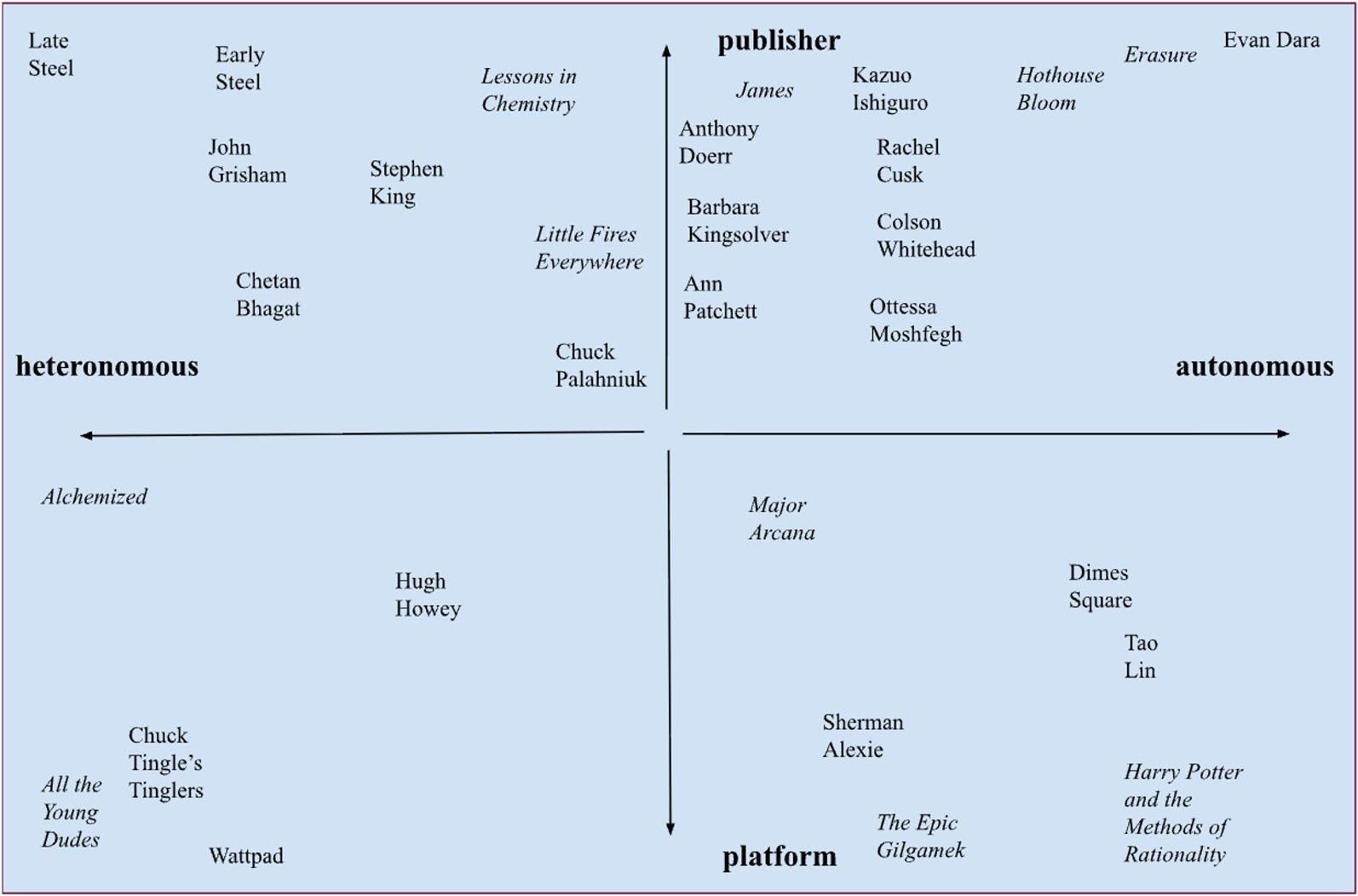
I’ll take a moment to explain the graph.
The vertical axis runs from platform on the bottom to publisher on the top. Platform = internet platform. AO3, Wattpad, KDP, Substack, born-digital magazines. I also use it, here, crudely to mark how “online” a work or author is. Publisher = traditional publisher. Someone who is entirely offline and only in public through their publisher will be at the top of the graph.
The horizontal axis runs from heteronomous on the left to autonomous on the right. This is a distinction from sociologist Pierre Bourdieu. In a rough-and-ready sense, heteronomous means the work or author values something other than art (money, popularity, connection). Autonomous means the work or author values art above all.
The grid is a vulgarization of a Greimas square, from the Lithuanian linguist Algirdas Greimas, popularized by theorist Fredric Jameson as a way to organize culture at scale, though this version also owes a lot to Bourdieu’s field theory.
On the autonomous side of platform lit we find a refuge for so-called canceled writers no longer at home with publishers, such as Sherman Alexie, Junot Díaz, and Tao Lin. Here, too, we find young writers disaffected with liberal and left culture who gathered around the neighborhood of Dimes Square in downtown New York City. These are descendants of Tyrant Books: periodicals such as Forever Magazine and The Mars Review; and writers such as Jordan Castro, Madeline Cash, Matthew Gasda, and Honor Levy. Neoreactionary Curtis Yarvin is intellectual godfather of this scene and links it to Silicon Valley through Peter Thiel, who funds some of it. The politics, like that of old avant-gardes such as Futurism and Vorticism, is illiberal, as espoused by Compact magazine, the Red Scare podcast, and Bronze Age Pervert. Substack is the platform of choice.
Like Gay Fantasia, fiction here expresses a sincerity enabled by a rejection of the culture of traditional publishing. “They’re trying to carve out their own space,” writes critic Sam Kriss, “away from the prissy bullshit of the mainstream literary world, where they can write something real.” They strive “toward a mode of writing that’s unmannered, unaffected, and natural.” They want “raw surging nowness.” Unlike Gay Fantasia, the sincerity of this fiction is not in pursuit of fan service or customer satisfaction but Art. They want to create literature that is new and will last.
The editors of Forever Magazine want “prose that isn’t risk-averse.” They privilege “style over plot.” They “really care about language.” Prizing novelty, they make themselves illegible to the industry’s conservative logic grounded in justifying acquisitions by similarity to what has worked recently—until, at least, they find success among their restricted but culturally capitalized audience, which clout-hunters in the industry can then leverage. Unlike the Art Novel, home in the upper-right corner, this fiction is steeped in the internet, which suffuses the style: absurdist, garish, often larded with online jargon. “Our readerly sensibility has become more unhinged,” say the editors of Forever Magazine. “It takes more to get our attention.” The fiction here tends iconoclastic, anti–cancel culture, anti-woke. The leading contradiction is between the impulse toward novelty and a pull toward old ways, often expressed by affection for Catholicism, or Simone Weil. “‘Reject modernity, embrace tradition,’” offers one of the editors of Forever Magazine, as a slogan. “I think that’s reflected in what was initially the sort of godly aesthetic of the website. And now we kind of just want it to be an expansive heaven, something symbolic of ‘forever.’” Similarly, Noah Kumin, editor of The Mars Review, wants “to destroy the literary practice of modernism,” which he defines as “the immense overvaluation of individual subjectivity in literary art” and which, he argues, “has led literature to a dead end.” He wants instead what he calls, borrowing from Aldous Huxley, “perennialism”: “the belief that an ancient wisdom older than (or at least developing separately from) the Abrahamic religions is at the core of a mysterious mode of thought.”
(Curtis Yarvin also links Dimes Square to Silicon Valley rationalism through his early important role with Eliezer Yudkowsky’s blog LessWrong. Yudkowsky expressed his ideas most famously in his novel Harry Potter and the Methods of Rationality, which runs 660,000 words and 122 chapters and is thus something like All the Young Dudes in a funhouse mirror. Yudkowsky is best known for arguing that superintelligent AI will annihilate humanity. Though he has disavowed Yarvin, he is an illiberal technocrat skeptical of democracy.)
For its illiberalism, its vanguardist fondness for tradition, its flirtations with fascism, I call this type Avant-Fash.
it's been sad to watch supposedly smart people come to believe that having commitments and interests practically identical to those of various billionaires and heads of state is in any way real, new, or good.
— signed, a Tyrant Books author
Thanks, very interesting. I wonder about “illiberal” as a label, and Futurism as a point of reference. Along with its misogyny and interest in mechanized violence, Marinetti’s Futurism also advocated women’s suffrage, freedom of the press, etc. I think of it as part of the history of avant-gardes, as in Peter Bürger’s book.
What’s most surprised me about Substack literary culture in this quadrant is its nostalgia. I see it not only in the statements and manifestos, but in the choices of writers to study (in my view, that includes the Substack writers who lavish attention on Horace, Dante, Shakespeare, and Victorian authors, as much as on Eliot and Joyce). From my perspective, looking from the history of visual arts across at literature, the entire quadrant is odd. The closest parallels are marginal in the visual arts: Odd Nerdrum’s embrace of a version of the 17th century (propped up by a new definition of kitsch), Vincent Desiderio, Bo Bartlett, F. Scott Hess, etc. But I can’t see a sociological parallel.